

How To Install A New Hose Bib
How to Install a Frost-Proof Outdoor Faucet
This inexpensive faucet can salve thousands in water damage—and prevent water contamination
 Time
Time
A total day
 Complexity
Beginner
 Cost
Cost
$51–100
Introduction
Frost-proof, anti-siphon sill erect faucets prevent wintertime h2o-line freeze-ups and stop unsanitary h2o from contaminating the water system. Here's how to install ane in your house.
Tools Required
Materials Required
- Anti-siphon sill cock
- Copper fittings
- Copper pipe
- Dielectric fitting (optional)
- Flux
- Lead-gratis solder
- Pipe hangers
- Pipe tape
- Shutoff
- Silicone caulk
Overview: How to install a frost-proof outdoor faucet
In contempo years, outdoor water faucets (sill cocks) and a water spigot have undergone two great improvements:
- Start, a frost-proof sill cock (Figure A, below) puts the faucet's flow valve well within the heated walls of your domicile. That ways if a sudden freeze occurs or you forget to shut down and drain the water spigot h2o line for the wintertime, your chances of having a pipe burst driblet dramatically.
- 2nd, an anti-siphon device (vacuum breaker in a water spigot), now required by all building codes, is built into some new sill cocks (or tin be added on to existing ones; step 11). Information technology prevents unsanitary h2o from being pulled back through a garden hose and contaminating your water system.
Nosotros'll show y'all how to install freeze-proof sill cocks on an outdoor water faucet, anti-siphon valves and shutoff valves that will safeguard your home. The piece of work will include connecting new fittings or soldering (also called "sweating") copper joints. Plus, salvage money by doing simple plumbing repairs yourself. These fixes are completely DIY with basic tools and skills.
Notation: Our habitation has a galvanized piping system. The parts and installation techniques shown in the step-by-step photos are the same for copper plumbing. If you have a CPVC plastic system, even so, the parts will look like to those shown in Figure B (below).
Project pace-past-step (13)
Pace one
Call kickoff for local plumbing rules
When you upgrade a sill cock, call your plumbing inspector to check on local requirements. (You lot may need a permit, also.) Although plumbing codes and enforcement vary around the country, more often than not they require:
- 3-quarter inch (minimum) inside diameter supply pipes to each sill cock. Some local codes but require 1/two-in. pipe and a 1/two-in. sill cock.
- Either an approved vacuum billow that permanently attaches to standard sill cocks (step 11) or a sill erect with the characteristic congenital in (step 7) to foreclose siphoning.
- A shutoff valve, also called a "stop" valve, to serve each sill erect. Our code required united states of america to install a shutoff with a built-in drain known as a "stop and waste" valve (Figure B, below).
- If yous have galvanized steel pipe and must make a transition to copper, install a special dielectric fitting (footstep viii) to prevent corrosion.
Pace two
Freeze-Proof Strategy
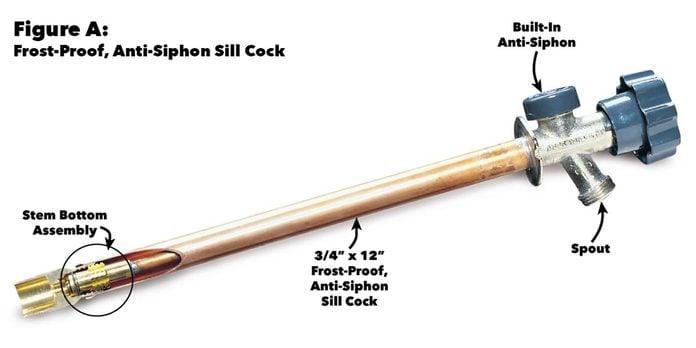
The frost-proof feature works by shutting off water flow dorsum at the stem bottom (inside a heated infinite). The anti-siphon characteristic is congenital into the water spigot. Install the sill cock through a wall with a slight downward pitch to allow any remaining water to bleed out through the h2o spigot.
If your home is congenital on a slab:
If your house is congenital on a concrete slab, a frost-proof sill cock won't piece of work in most cases. Instead, connect a standard sill cock that's fitted with a vacuum breaker. If freezing is a business organization, install a "stop and waste product" valve on the pipe as close to the sill cock as possible (yet inside a heated area).
Build in an admission panel so you tin can readily open and shut the valve. In the winter, to avert having your sill erect and pipes freeze, shut the shutoff valve, uncap its drain to allow air to enter, and open up the sill erect to let whatever h2o run out. Don't change these fixture settings until warmer weather permits using the sill cock once again.

Step iii
Make a sketch and a parts list

Measure your existing plumbing and list the inside bore of the existing pipe, the thickness of the outside wall, the linear anxiety of new piping and the types of fittings needed.
Draw where each piping and fitting goes; indicate whether a part has threaded, sweat or solvent-welded joints; and label its size and description (for example, 3/4-in. copper female adapter). Then sketch the new plumbing layout to use for a materials listing.
Step 4
Make a shopping listing
If y'all have galvanized pipe, nosotros recommend you unscrew the pipe back at the offset coupling or fitting (steps 3 – 6). So insert a dielectric fitting (footstep 8) and convert to copper piping and fittings all the way back through to the sill cock.
Frost-proof, anti-siphon sill cocks are available in 1/2-in. and 3/4-in. inside diameters, and viii-in., 10-in. and 12-in. lengths (pace 7). Choose the bore required by your local code and a length that will accommodate the thickness of your outside wall plus give you some working room within to adhere pipe and fittings.
We likewise installed a 3/4-in. "full-port" (for unobstructed water menses) ball valve with bleed. There's no neoprene washer to wear out, and the easy-to-turn handle shows whether the valve is open or closed (step 9).
Stride 5
Putting it all together: Remove the onetime water spigot
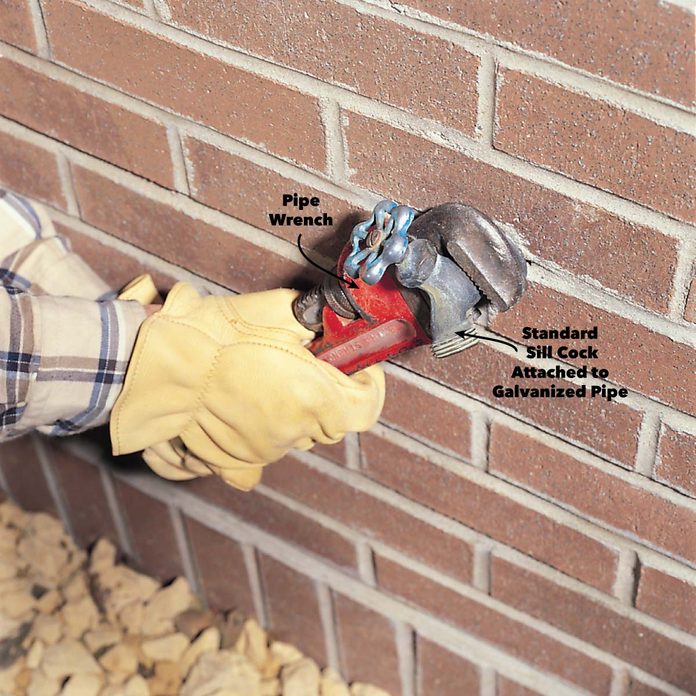
Turn off either the water shutoff valve to the existing sill erect or the chief water supply. Open the sill cock and drain the water from the line. Remove the quondam outdoor water faucet sill erect by positioning a piping wrench at the back of the sill erect and turning the wrench counterclockwise. Have an banana use a pipe wrench to hold back the sill cock supply line inside to prevent sections of pipe from unscrewing.
Step half-dozen
Turn off the next pipe
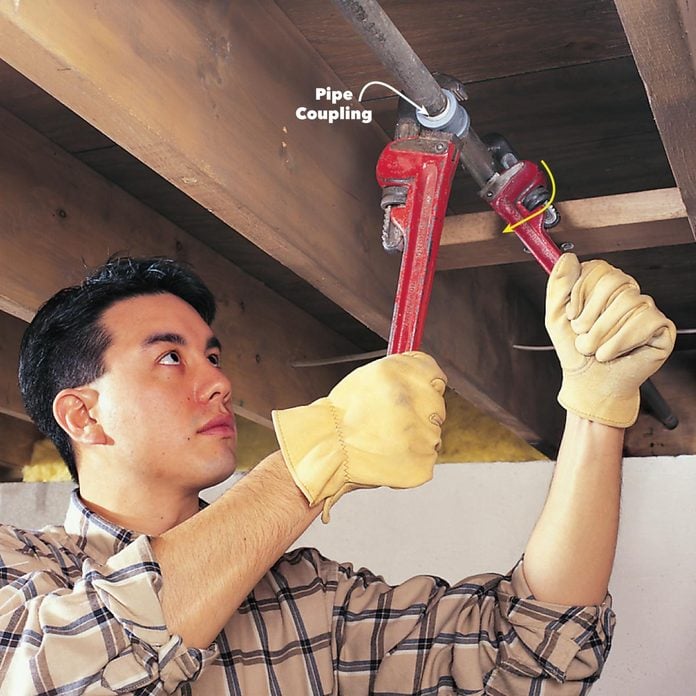
Unscrew the old piping at the articulation closest to the outside wall. Concur one side stationary with one pipe wrench and twist off the pipe with the other. Remove as many couplings and pipes as needed to fit in the new associates (step viii).
Step 7
Insert the new sill cock
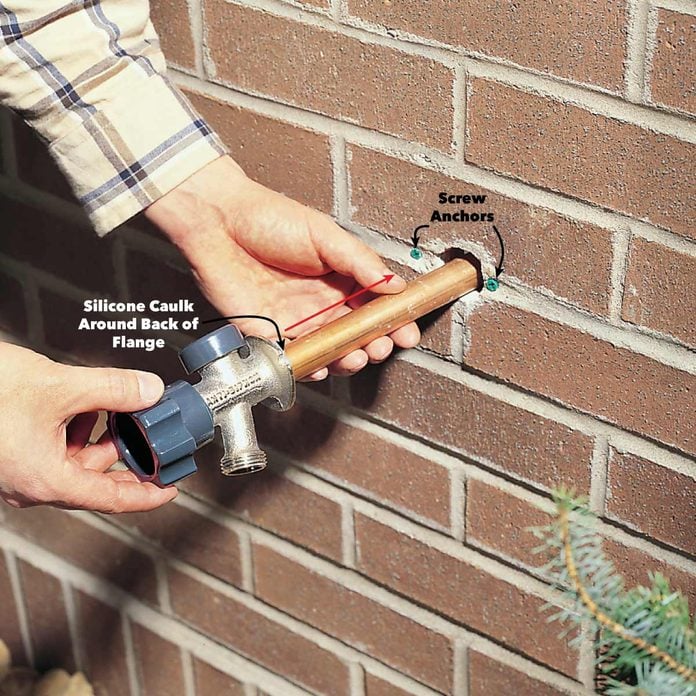
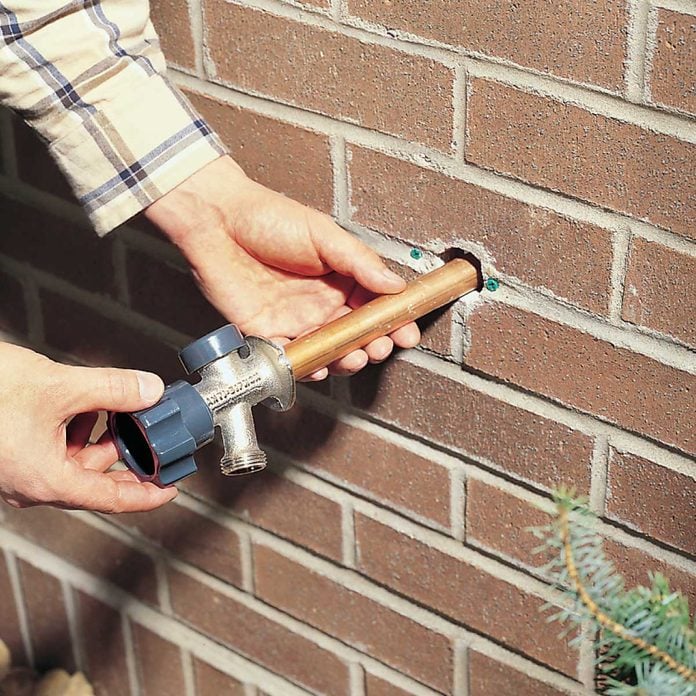
Bore a ane-1/8 in. hole (if the hole needs enlarging) for the new sill cock using a masonry pigsty saw. Dry-fit the sill cock in an upright position tight confronting the wall and mark the location of the fastening holes. Drill two i/4-in. holes with a masonry drill chip and push the plastic spiral anchors in flush to the wall. Apply a thick bead of clear silicone effectually the back of the sill cock flange, push it confronting the wall and spike it with ii 1-1/4 in. No. viii roundhead brass screws.
Pace 8
Attach the dielectric fitting
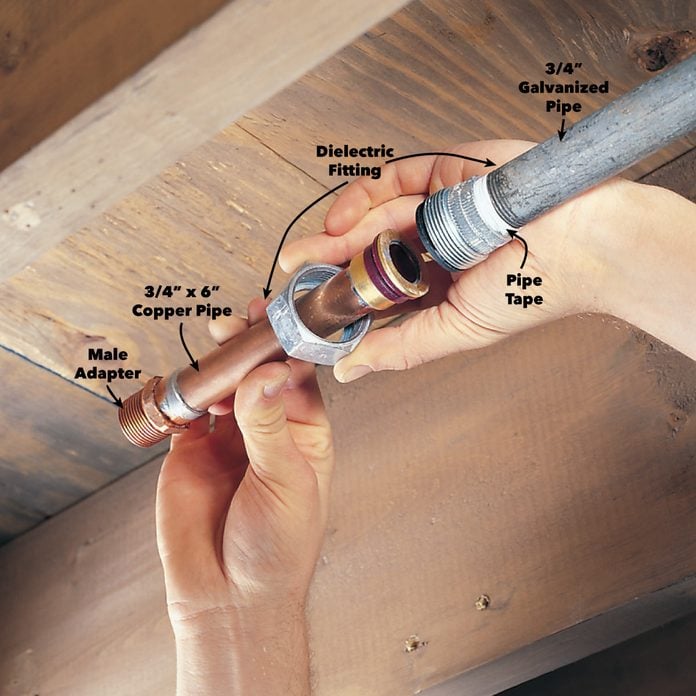
Start from the onetime pipage finish and work toward the new sill cock. It's easier to solder copper fittings to copper pipage and then spiral them into hard-to-sweat parts like the ball valve and sill erect.
Disassemble the dielectric plumbing fixtures and solder one end to a half dozen-in. copper pipage. Cool the pipe and reassemble the plumbing fixtures. Then solder the copper male adapter to the other stop. Apply pipe tape to the threads of the galvanized pipe and tightly screw the dielectric plumbing fixtures to the pipe.
Step 9
Assemble the pipe and fittings
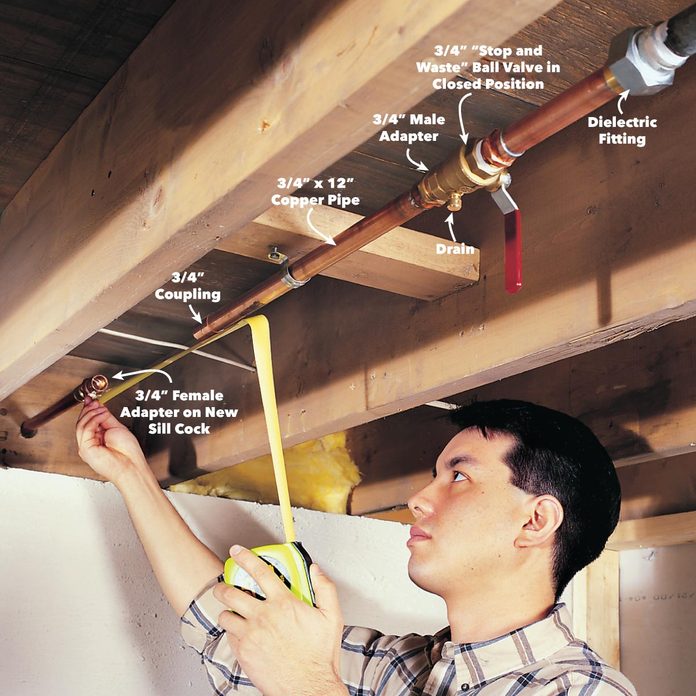
Use pipe tape to the male person adapter threads on the six-in. pipe (shown in the previous step), and screw the "finish and waste" ball valve to it. The water menstruation management pointer on the valve must point toward the sill erect. Solder a male adapter to a 12-in. copper pipe, use pipe tape to the adapter threads and screw information technology into the other side of the brawl valve. Temporarily spiral a female adapter to the sill cock and slide a female coupling halfway onto the finish of the 12-in. pipage. Then measure the altitude between them, add 1 in. and cut a section of iii/four-in. copper pipage to fit.
Step 10
Sweat the copper

Solder on the iii/iv-in. coupling last. Remove the female adapter and solder information technology to the copper piping. Then employ pipe tape to the male person threads, and screw the adapter onto the sill cock. Solder both copper pipes into the coupling. When sweating the copper joints, open the sill cock, hold the torch on one side of the connection and the lead-free solder wire on the other side. Heat the joint for 10 seconds until the solder melts and flows around the connection. Loosen the pipe hangers along the pipe system to let maximum movement to fit this last connection. Now that you're done installing a frost-proof outdoor faucet, larn how to fix a leaking frost-proof faucet.
Step 11
Install an anti-siphon valve on an existing sill cock

Depending on how your outdoor h2o faucet sill cock is currently plumbed, you may find that purchasing and installing an anti-siphon valve (besides chosen a vacuum breaker) is all y'all need. Don't apply any pipage record or compound on the sill erect spout threads. To preclude adventitious removal or tampering by vandals, all plumbing codes require that vacuum breakers exist permanently installed. The breaker you buy will have either a setscrew (with a break-off head) that grips the spout threads or a characteristic to brand it hard to unscrew the breaker one time it's installed.
Stride 12
If you have a CPVC supply system:
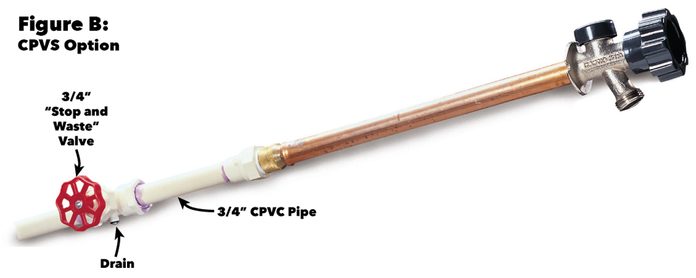
If you have a CPVC supply system (equally shown in a higher place in Figure B), omit the dielectric plumbing fixtures, buy a plastic shutoff valve (with drain) and solvent-weld the pipe and fittings together. Position the valve so that its h2o period direction arrow points toward the outside wall.
Step 13
More installation tips
For the all-time results:
- To install freeze-proof water spigot through brick or concrete foundations, it may be necessary to overstate the existing pigsty using a drill with a masonry pigsty saw. When drilling the larger hole, control drill wobble or "boot-out" past gripping the drill with two hands, keeping the hole saw centered on the one-time hole and running the drill at a lower speed when the saw starting time enters the pigsty.
- Utilise piping compound or pipe record to the male piping threads everywhere that threaded pipe and fittings join.
- Install new pipe level with the existing pipe when they're inside a heated space. Install pipes on a downwards slope if they drain toward an open sill cock once they go out the heated space.
- Space pipe hangers every iii ft. to support the piping. Utilise copper or plastic hangers on copper piping.
- After replumbing the sill cock, turn the water on for at least 2 minutes to flush out impurities.
- Uncouple your garden hose from the sill erect before wintertime. If hoses remain attached, frostproof sill cocks (whether open or closed) may freeze because water tin't completely drain out of them.
A plumber isn't obliged to tell y'all information technology'south an piece of cake gear up…and so check out 12 things your plumber doesn't want you to know.
Originally Published: May 22, 2022

Source: https://www.familyhandyman.com/project/how-to-install-a-frost-proof-outdoor-faucet/
Posted by: florahischat.blogspot.com
0 Response to "How To Install A New Hose Bib"
Post a Comment